The double challenge for Executive Interim Managers
Interim Management hat sich als strategisches Instrument moderner Unternehmensführung etabliert. Unternehmen setzen erfahrene Führungskräfte zeitlich befristet ein, um Vakanzen zu überbrücken, Krisen zu bewältigen oder Transformationsprozesse zu steuern1Uffmann, K. (2013). Interim Management: A Legal Analysis. Mohr Siebeck..
The particular challenge for executive interim managers, however, lies in managing two complex tasks simultaneously: seamlessly managing day-to-day operations and simultaneously implementing strategic change processes. This dual requirement requires structured process management that effectively coordinates both levels.
Two parallel process levels in interim management
The success of an interim mandate depends largely on the professional design of two parallel process levels:
Process Level 1: Taking Over Day-to-Day Business. Ensuring continuous operational business operations is the foundation of every successful interim mandate. Without stable day-to-day management, the company loses its ability to act.
Process Level 2: Process Change: The strategic transformation of the company takes place parallel to day-to-day business management. These change processes aim to achieve sustainable improvements in corporate performance.
Coordinating both levels requires a systematic approach and clear process structures in order to utilize synergies and avoid conflicts.
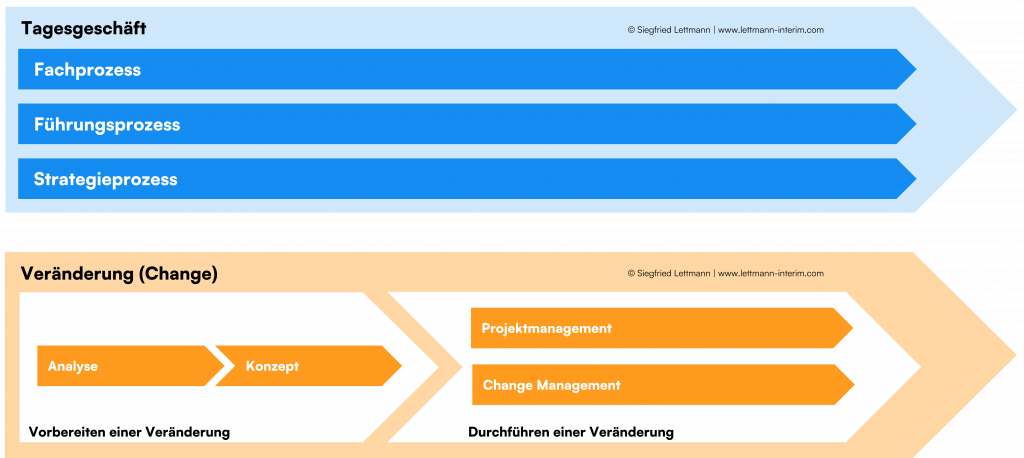
Taking over day-to-day business: Three critical sub-processes
1. Technical process: Ensuring operational excellence
The functional process encompasses all operational activities required to maintain business operations. Executive interim managers must quickly familiarize themselves with complex functional areas and assume operational responsibility.
Core elements of the specialist process:
- Analysis of existing workflows and process structures
- Identification of critical success factors and bottlenecks
- Ensuring quality standards and compliance requirements
- Optimization of operational processes during ongoing operations
Die Geschäftsprozessoptimierung erfolgt dabei kontinuierlich und berücksichtigt die spezifischen Anforderungen des Unternehmens. Schmelzer und Sesselmann definieren Geschäftsprozessmanagement als “integriertes System aus Führung, Organisation und Controlling zur zielgerichteten Steuerung und Optimierung von Geschäftsprozessen”2Schmelzer, HJ, & Sesselmann, W. (2013). Business Process Management in Practice. 9th edition, Hanser Verlag..
2. Leadership process: Managing teams effectively
The leadership process focuses on managing and developing teams. Interim managers temporarily assume leadership responsibility and must quickly build trust.
Key management tasks:
- Building trust and credibility among employees
- Clear communication of goals and expectations
- Motivation and development of team performance
- Decision-making under time pressure
Leadership effectiveness is a key factor in determining the success of the entire interim mandate. Employees must accept and actively support the temporary manager.
3. Strategy process: Developing future viability
The strategy process combines operational excellence with long-term corporate development. Interim managers must evaluate and further develop existing strategies.
Strategic fields of action:
- Assessment of current market positioning
- Identification of strategic opportunities and risks
- Development of sustainable business models
- Alignment between operational measures and strategic goals
The integration of strategic considerations into day-to-day business creates the basis for sustainable corporate success.
Process change: Systematic transformation
Preparing for change: analysis and synthesis
The preparation of structured change processes takes place in two successive sub-processes:
Analysis Process: Foundation for Change The analysis process creates the data foundation for informed decisions. Executive interim managers conduct systematic company analyses and identify potential for improvement.
Key elements of the analysis:
- Structured analysis of existing processes and structures
- Identification of profit potential and optimization opportunities
- Assessment of corporate culture and willingness to change
- Analysis of competitive position and market dynamics
Synthesis process: developing solution concepts
The synthesis process transforms analysis results into concrete action plans. Interim managers develop tailored solutions for identified challenges.
Central synthesis tasks:
- Development of concrete improvement measures
- Prioritization of fields of action according to probability of success
- Design of implementable solution concepts
- Creation of detailed implementation roadmaps
Implementation of change: Project management and change management
The implementation of change processes takes place through the parallel application of project management and change management methods:
Projektmanagement: Strukturierte Umsetzung Das Projektmanagement gewährleistet die termingerechte und budgetconforme Umsetzung definierter Veränderungsmaßnahmen3Timinger, H. (2017). Modern Project Management: Achieving Success with Traditional, Agile, and Hybrid Approaches. Wiley-VCH.. Interim Manager fungieren als Projektleiter und koordinieren verschiedene Arbeitspakete.
Project management core elements:
- Structured project planning with clear milestones
- Resource allocation and budget control
- Risk management and quality assurance
- Continuous project controlling and reporting
Change Management: Winning People Over for Change . Change management addresses the human dimension of change processes. Interim managers must overcome resistance and foster acceptance of innovations.
John Kotter identifizierte in seinem 8-Stufen-Modell die kritischen Erfolgsfaktoren für Change Management4Kotter, J. P. (1996). Leading Change. Harvard Business School Press.. Das Modell betont die Bedeutung von Kommunikation, Führung und kultureller Verankerung für nachhaltigen Wandel5Kotter, J. P. (2007). Leading Change: Why Transformation Efforts Fail. Harvard Business Review, 85(1), 96-103..
Change management focuses:
- Communication of the need for change
- Building coalitions for change
- Training and development of employees
- Cultural anchoring of new ways of working
The combination of structured project management and people-oriented change management maximizes the probability of success of transformation processes.
Practical success factors in interim management
Optimally control parallelism
Managing day-to-day business and transformation simultaneously requires specific management skills:
- Zeitmanagement: Interim Manager müssen ihre Arbeitszeit effektiv zwischen operativen Aufgaben und strategischen Projekten aufteilen6Groß, H., & Bohnert, R. (eds.). (2007). Interim Management: Successfully Managing Corporate Change – with Temporary Managers. Vahlen Verlag..
- Delegation: Effective delegation of operational tasks creates space for strategic work. Interim managers continuously develop their teams and gradually delegate responsibility.
- Communication: Transparent communication across both process levels prevents confusion among employees and stakeholders. Regular updates build trust and acceptance.
Continuous knowledge transfer
The transfer of knowledge to internal managers ensures the sustainability of the changes:
- Mentoring: Interim managers develop potential successors through targeted mentoring. Experienced knowledge is systematically transferred and embedded.
- Documentation: Structured documentation of processes and decisions enables seamless handovers. Knowledge management becomes a critical foundation for success.
- Training: Targeted training programs qualify internal employees for expanded areas of responsibility. Skills development is sustainably promoted.
Measurable success control
Success is measured at both process levels using specific key performance indicators:
- Operational metrics: Quality, productivity, customer service, and cost efficiency measure day-to-day business performance.
- Transformation metrics: Project progress, employee satisfaction, process improvements, and strategic goal achievement evaluate the success of the change.
Erfahrungswerte zeigen, dass professionelles Interim Management messbare Verbesserungen in Profitabilität und Effizienz ermöglicht7Rybnikova, I. (2007). Interim Management: Analysis of an Atypical Form of Employment for Executives. Springer Gabler..
Conclusion: Interim management as a strategic success tool
The systematic design of processes in interim management requires the simultaneous mastery of operational and strategic challenges. Executive interim managers must manage day-to-day operations and transformation simultaneously to ensure sustainable corporate success.
The key lies in a structured approach: Clear process definitions, systematic project management, and people-oriented change management lay the foundation for successful interim mandates. Coordinating both process levels requires experienced leaders with proven transformation expertise.
Companies that strategically utilize interim management benefit from flexible solutions to complex challenges. Investing in professional interim managers pays off with measurable improvements in profitability, efficiency, and sustainability.
The future of interim management lies in the further professionalization of process design and the continuous development of proven methodologies. Companies that recognize and utilize this potential early on will secure decisive competitive advantages.